
Local Government Reorganisation (LGR)
What is Local Government Reorganisation (LGR)?
In Nottinghamshire local services are currently delivered under a ‘two-tier’ structure. Nottinghamshire County Council is responsible for services such as social care, education, and road maintenance across the whole of Nottinghamshire (except within Nottingham City). The 7 district and borough councils are responsible for services specifically within their areas, such as; waste collection, parks, and leisure centres. Nottingham City Council is a ‘unitary authority’ providing all council services within it’s boundaries.
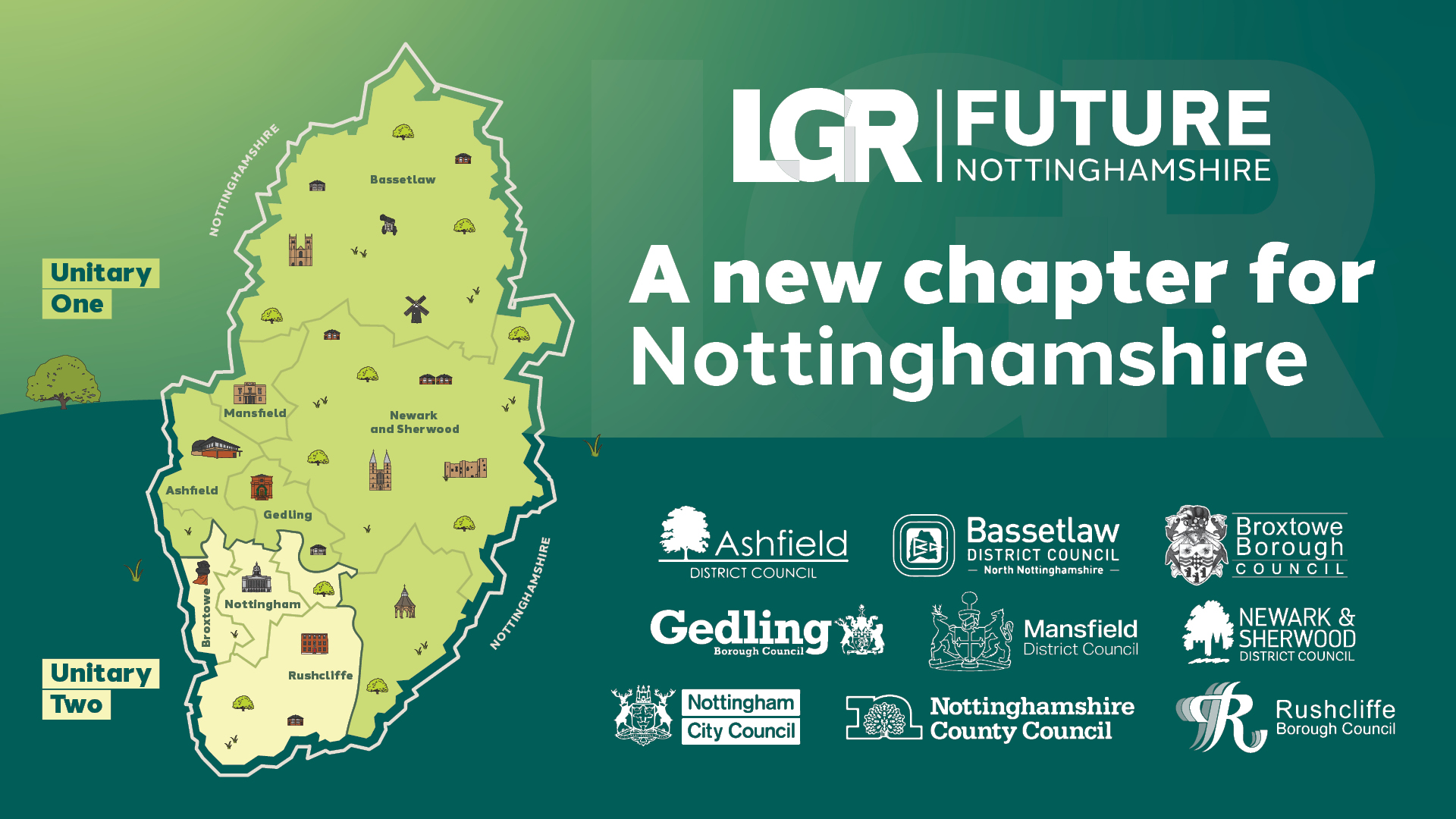
LGR will see the 9 existing local authorities abolished to create 2 new unitary councils with a higher population of residents, responsible for all local services in those areas.
The current 9 local authorities are;
- Ashfield District Council
- Bassetlaw District Council
- Broxtowe Borough Council
- Gedling Borough Council
- Mansfield District Council
- Newark and Sherwood District Council
- Nottingham City Council
- Nottinghamshire County Council
- Rushcliffe Borough Council
The decision to proceed with LGR was taken by central government in 2024. Government say that the aim of LGR is to create more efficient and effective local government, potentially leading to streamlined services and cost savings.
What has happened so far?
There is a dedicated website in respect of LGR in Nottingham and Nottinghamshire - LGRNotts.org - where more detailed information can be found.
This is the progress to date;
- November 2024: Publication of a Government white paper outlining plans.
- February 2025: Government writes to local authorities formally inviting them to submit proposals to create new structures of unitary authorities.
- Autumn 2025: Public engagement exercises across Nottinghamshire on LGR.
- November 2025: Submission of proposals made to Government.
- February/March 2026: Government consults stakeholders on the proposals.
- July 2026: Government announces decision on proposals.
What were the proposals?
Detailed information in respect of the proposals can be found on the LGRNotts website.
The proposals put forward were;
Option 1b
- Nottingham City Council + Broxtowe Borough Council + Gedling Borough Council
- Nottinghamshire County Council + Ashfield District Council + Bassetlaw District Council + Mansfield District Council + Newark and Sherwood District Council + Rushcliffe Borough Council
Option 1e
- Nottingham City Council + Broxtowe Borough Council + Rushcliffe Borough Council
- Nottinghamshire County Council + Ashfield District Council + Bassetlaw District Council + Gedling Borough Council + Mansfield District Council + Newark and Sherwood District Council
Option Bii
- Nottingham City Council + parts of Broxtowe Borough Council, Gedling Borough Council and Rushcliffe Borough Council
- Nottinghamshire County Council + Ashfield District Council + Bassetlaw District Council + Mansfield District Council + Newark and Sherwood District Council + parts of Broxtowe Borough Council, Gedling Borough Council and Rushcliffe Borough Council
Different councils are supporting different options and approved the respective submission. The details of this are as follows;
Option 1e supported by:
- Bassetlaw District Council
- Gedling Borough Council
- Mansfield District Council
- Newark and Sherwood District Council
Option Bii supported by:
- Nottingham City Council
Option 1b supported by:
- Nottinghamshire County Council
- Rushcliffe Borough Council
Ashfield District Council’s Cabinet resolved to not express a preference for a single option – a position that reflects the profound geographic, economic, and social distinctions within Ashfield, Nottingham, and Nottinghamshire. However, it was stressed that this was not a lack of commitment to reform or collaborate, and that regardless of the Government's final choice, they would ensure active, positive involvement in implementation.
Members at Broxtowe Borough Council resolved not to support any of the proposals. Instead, they agreed to submit a Potential Impacts Assessment on the impact of LGR on Broxtowe residents and to write to the Secretary of State highlighting that the Council was not against Local Government Reorganisation in principle, but to call for the process to be halted in order for it to be considered more fully.
What happens next?
The current timeline of the process to follow is:
- From now onwards: The government now intends to make a Structural Changes Order (SCO). This is the legal document issued by the government to implement LGR. It sets out how the transition will be managed, establishes the new council arrangements, and provides the timetable and governance framework for moving from the current councils to the new authority structure.
The collaborative work that has already been going on across all nine councils will continue to oversee the transition.
- May 2027: Elections to the shadow authority. A shadow authority (or shadow council) is a temporary body elected to oversee the transition to the new authorities. The shadow authority will operate alongside the existing authorities for the year leading up the new authorities formally taking over
- 31 March 2028: Current local authorities are abolished
- 1 April 2028: Vesting Day – the new unitary councils are vested (formally created).
What does it mean for me?
Our priority remains unchanged: business as usual will continue as we deliver the services our residents rely on, while working collaboratively with partners to shape the future arrangements.
Where can I find out more?
There is a dedicated website for LGR in Nottingham and Nottinghamshire. The links to this can be found in the related links section of this page.
Related links
Page last updated 21 July 2026
Page feedback
This form is for feedback on the content of this page.
Please do not use this form to contact us about personal matters, as we cannot respond to requests sent this way. To get in touch, use the contact details or online forms provided on this page.