
Damp and mould control policy
Version 1 - April 2026
Contents
Ashfield District Council (ADC) is committed to providing safe, healthy, and well-maintained homes for the tenants of its housing stock. Damp and mould can have a serious impact on the condition of a property and the wellbeing of the people who live in it.
Ashfield District Council as a Landlord is obliged under the terms of its tenancy agreement to keep the structure and outside of its tenanted properties, including communal areas in good repair.
In line with national expectations for social landlords and the strengthened responsibilities introduced through recent housing legislation, the Council recognises the importance of acting quickly, consistently, and effectively to prevent, identify, and remedy damp and mould issues in its housing stock.
This Damp and Mould Policy set out Ashfield District Council’s approach to managing these hazards. It outlines how the Council will investigate concerns, support tenants, address underlying causes, and ensure timely and appropriate repairs. The policy also reinforces the shared responsibility between the Council and its tenants to maintain good housing conditions, promote early reporting, and prevent problems from escalating.
Through this policy, Ashfield District Council aims to ensure that every home meets modern standards of safety, comfort, and decency, and that all residents can live in a warm, dry, and healthy environment. If issues do arise, the Council will respond transparently, fairly, and within clear timeframes, placing the health and wellbeing of tenants at the centre of its decision making.
Guidance has been referred to in the development of this Policy to ensure compliance with ‘Awaab’s Law’ when dealing with damp and mould:
This Policy applies to all Council-owned properties within its Housing Revenue Account (HRA), including temporary accommodation. It extends to Council staff, residents and contractor operatives. It ensures that all parties are aware of their responsibilities and obligations when reporting and managing damp and mould and helps to maintain safe homes and shared areas for residents to live in and access.
The Policy applies to leasehold properties only where the presence of damp and mould is attributable to structural or external elements that fall under the Council’s responsibility as landlord and freeholder. These may include but are not limited to, and will be dependent on the leasehold agreement, rising damp within walls, penetrating damp through external walls, and water ingress through roofs and / or attached balconies. In such cases, we will take appropriate remedial action in line with our obligations under this Policy and relevant legislation.
The Policy aims are to ensure that the Council provides and maintains homes that are safe, healthy and provide a comfortable environment for our tenants, as well as protect the structure and quality of our properties. The key aims are to:
- Improve our understanding of the housing stock in relation to damp and mould and have proactive programmes for managing this issue
- Ensure that our statutory obligations under Awaab’s Law are upheld, and that remedial action is taken within the specified timescales to safeguard resident health and maintain housing standards.
- Work in partnership with residents ensuring that a safe and healthy internal environment is provided.
- Undertake effective investigations and implement reasonable remedial repair solutions and improvements to eradicate damp and mould, including advice for preventing, managing and controlling condensation.
- Provide relevant training to operations staff to ensure that they can conduct their duties effectively.
- Establish detailed procedures and agree accepted practices relating to the provision of the service and this policy.
The scope of this policy is covered by the following:
- Defective Premises Act 1972
- Health & Safety at Work etc. Act 1974
- Housing Act 1985
- Landlord and Tenant Act 1985
- Environmental Protection Act 1990
- Secure Tenants of Local Housing Authorities (Right to Repair) Regulations 1994
- Housing Act 1996
- Housing Act 2004
- Housing Health and Safety Rating System (HHSRS)
- The Regulatory Reform (Fire Safety) Order 2005
- Decent Homes Standards 2006
- Building Regulations 2010
- The Control of Asbestos Regulations 2012
- Construction (Design and Management) Regulations 2015
- Homes (Fitness for Human Habitation) Act 2018
- Housing Ombudsman Service Report
- Building Safety Act 2022
- Fire Safety (England) Regulations 2022
- Building (Higher-Risk Buildings Procedures) (England) Regulations 2023
- Social Housing (Regulation) Act 2023
- Regulator of Social Housing – Safety and Quality Standard 2024
- The Hazards in Social Housing (Prescribed Requirements) (England) Regulations 2025 (Awaab’s Law
The Hazards in Social Housing (Prescribed Requirements) (England) Regulations 2025 (Awaab’s Law) came into force from 27 October 2025. From this point social landlords must address all emergency and significant hazards, including all damp and mould hazards that present a significant risk of harm to tenants within fixed timeframes. The Regulations will be further expanded to address further hazards in 2026 and 2027.
Awaab’s Law is a legal requirement under the Social Housing (Regulation) Act 2023 that obliges social landlords to investigate and resolve damp, mould and serious hazards within strict timeframes.
Awaab’s Law was introduced following the death of Awaab Ishak, who died following extensive exposure to damp and mould in his home. The law focusses specifically on the timescales for landlords to respond to complaints of damp and mould in social housing homes. Section 42 of the Social Housing (Regulation) Act 2023 introduced Awaab’s Law, setting legally binding timeframes for social landlords to investigate and resolve health and safety hazards. Landlords must act quickly on issues such as damp and mould, with clear deadlines for assessment, communication and repair. The regulations also extend to other risks including structural faults, electrical hazards, poor ventilation and unsafe stairways.
Under this new law Landlords must assess and act on dangerous damp, mould and emergency hazards within 24 hours, with repairs completed within the required regulatory timescales.
As of 2026, social landlords must follow a 24-10-3-5 rule for hazards: 24 Hours: Max time to investigate and ‘make safe’ any emergency hazard (imminent risk). 10 Working Days: Max time to investigate a significant hazard (such as damp, mould and now excess cold or fire risks). 3 Working Days: Max time to provide the tenant with a written summary of the investigation findings. 5 Working Days: Max time to begin remedial safety works if a significant hazard is found.
Phase 1 of Awaab's Law, introduced as part of the Social Housing (Regulation) Act 2023 came into force 27 October 2025. Phase 1 of Awaab’s Law specifically covers significant, and emergency hazards linked to Damp and Mould.
5.1 Definition of damp
Damp in a home is the unwanted presence of excess moisture in walls, floors, or ceilings, often causing structural damage, mould growth, and a musty smell.
There are 2 causes of damp in a home:
- Damp which is caused by moisture from within the home.
- Damp which is caused by moisture entering from outside the home.
Damp from external sources includes rising damp from the ground, rainwater leaks, poor drainage, or defective plumbing. Condensation damp is caused by the humidity in homes due to the moisture released into the air from activities such as cooking, bathing, and breathing. In homes, condensation damp is more of a problem during periods of cold weather as the water vapour carried in the air is more likely to condense on walls and windows. Damp caused by exterior sources of moisture such as rising or penetrating damp are generally worse in wet weather.
You can often tell what is causing damp by its appearance. Condensation tends to form patches of mould on walls and ceilings away from an obvious source of moisture, whereas rising damp will normally be found as a stain rising about 1 metre from the floor on the ground level of the home and penetrating damp will form around its source – such as a leaking window frame, a broken pipe, or a hole in your roof.
Damp is the cause of a variety of problems in the home, and the causes need to be removed as quickly as possible. Without action, damp issues affect the fabric of the property. Plaster will start to crumble, wallpaper and paint will start to blister and peel away, and wood skirting boards, window frames and furniture will start to rot. Wherever damp is present, mould and dust mites can thrive. These can cause numerous health problems including allergies and fatigue.
5.1.1 Condensation damp
Condensation damp occurs when moisture within the home cools and condenses onto colder parts of the building (for example, window frames, corners, and low points on walls behind sofas or wardrobes). This is the most common form of damp.
- Original construction:
the original construction of the property could mean it is more prone to condensation; poor insulation, lack of ventilation, solid walls, single glazed windows, nonbreathable materials, and design flaws, this is more common in older buildings. Condensation may also result from environmental conditions, including: - Poor ventilation:
not opening windows, blocking vents, not using extractor fans, and restricting air circulation around furniture. - Insufficient heating:
not heating the home adequately, often due to fuel poverty. - High humidity:
activities like cooking without covering pans and drying laundry indoors. - Cluttered spaces:
lack of space around possessions and storage, hindering air flow through the property.
5.1.2 Penetrating damp
Penetrating damp is water that gets into the building from outside due to defects in the walls, roofs, windows or floors.
5.1.3 Rising damp
Rising damp occurs when moisture from the ground travels upwards through building components in contact with the ground, such as walls and floors. This issue is commonly found in older properties.
5.1.4 Traumatic damp
Traumatic damp can be caused by leaking water from waste and heating pipes, overflowing baths or sinks, burst pipes or defective water storage vessels inside the building. Traumatic damp can also originate from outside the property, for example from another building or from environmental flooding.
5.2 Definition of mould
Mould is a type of fungus that grows in damp, humid, or poorly ventilated conditions, feeding on organic materials like wood, paper and carpet. It appears as fuzzy black, white, or green patches, often causing musty smells and potential health issues like respiratory problems or allergies.
Its primary cause is driven by condensation, high humidity, or leaks and is commonly located in areas like bathrooms, kitchens and on cold exterior walls.
5.3 Health impacts of damp and mould
Damp and Mould within the home can be harmful to the health of residents. Exposure to spores can cause a wide range of symptoms including rashes, itchy eyes, sneezing, coughs, dizziness and nausea. The long-term effects of mould exposure can be more severe for vulnerable people, people with respiratory conditions and those with weakened immune systems. The elderly, children and those with existing allergies are all considered to be more susceptible to mould exposure, and it is acknowledged that living in poor environmental conditions can impact on an individual’s sense of well-being and mental health.
There are a variety of housing conditions that put people at an increased risk of exposure to damp and mould.
These include:
- Homes where residents feel unable to open windows due to concerns about security, noise, or high outdoor pollution.
- Homes that are poorly or inadequately insulated.
- Homes with inefficient or ineffective and expensive to run heating systems.
- Homes that are poorly ventilated.
- Homes without adequate damp proof courses.
- Homes that are poorly maintained.
- Homes that are overcrowded.
Any resident or tenant with concerns about damp and mould in their home should contact Ashfield District Council immediately:
- post:
Ashfield District Council
Urban Road
Kirkby in Ashfield
Nottingham
NG17 8DA - telephone: 01623 457999
- email: housingrepairs@ashfield.gov.uk
- online: You can request a repair through the Tenant Portal or online
The Council will endeavour to rectify standard non-urgent damp and mould repairs within 30 days from the date of receipt of the report. However, there may be occasions when demand for the Repairs service exceeds the ability to supply, which means this timeframe can take longer. Affected residents will be advised if this is likely to happen. The Council will prioritise the most vulnerable of residents.
7.1 Commitment
At Ashfield District Council we are committed to: Prioritising the investigation, cause, and removal of damp and mould. Planning improvements using data and Key Performance Indicators. Continually developing communication, both internally and with our residents Continually developing and providing staff training.
Ashfield District Council will follow its Damp and Mould Procedures as outlined in our Procedural Document.
All reports of damp and mould reported directly to the Council will be reviewed, triaged and diagnosed by our Damp, Mould & disrepair team and the damp and mould procedure will be followed. Where necessary we will conduct an inspection to specify what remedial works are needed and then reinspect the property once the work has been completed. We will regularly review all reports of damp and mould.
Classifying the urgency of the repair will be in accordance with the following:
Definitions:
‘Significant’
A significant hazard is defined as a "significant risk of harm" to the health or safety of a tenant. A "significant risk of harm" is defined as "a risk of harm to the occupier’s health or safety that a reasonable lessor with the relevant knowledge would take steps to make safe as a matter of urgency".
‘Emergency’
An emergency hazard is defined as one that poses "an imminent and significant risk of harm" to the health or safety of the tenant. An ‘imminent and significant risk of harm’ is defined as "‘a risk of harm to the occupier’s health or safety that a reasonable social landlord with the relevant knowledge would take steps to make safe within 24 hours"
- Risk Category – Standard (PR30).
PR30 – would be treated as a non-urgent case and would fall out of scope for Awaab’s Law. - Risk Category – Potential Significant (PR10)
PR10 – would fall under the ‘Significant’ classification for Awaab’s Law and would require an investigation to take place within the stated 10 working days. - Risk Category - Potential Emergency (PR1)
PR1 – would fall under ‘Emergency’ classification for Awaab’s Law and would require immediate investigation (within 24 hours of report).
As part of our monitoring processes, the Council will maintain accurate records of damp and mould reports, including records of the remedial works carried out and any / all correspondence and communications.
7.2 Investigation and Response Times
The Council will follow the statutory response times set out under Awaab’s Law:
| Hazard Type | Investigation time | Written outcome | Start safety works | Further works deadline | Temporary accommodation |
|---|---|---|---|---|---|
| Emergency hazard | Within 24 hours | Within 3 working days | Within 5 working days | Within 12 weeks | Yes, if unsafe |
| Significant hazard | Within 10 working days | Within 3 working days | Within 5 working days | Within 12 weeks | Yes, if unsafe |
| Standard – non-urgent | As appropriate | As required | As required | As required | Not required |
7.3 Access arrangements
Ashfield District Council will seek to obtain access to the property to investigate and/or complete relevant safety works as quickly as possible, and records of attempts to gain access will be kept.
Tenant cooperation is required to manage damp and mould effectively. Tenants are expected to allow access to the property (in accordance with the tenancy agreement). In the case of repeated refused or missed appointments we will act in accordance with the tenancy agreement and take legal advice and / or action if necessary.
7.4 Council responsibilities
- The Council will:
Lead responsibility for ensuring all properties it owns or manages are maintained to a safe and habitable standard. - Investigate reports of damp, mould or condensation within agreed timescales.
- Diagnose root causes using trained staff or qualified surveyors.
- Carry out repairs promptly and professionally, addressing both immediate hazards and underlying causes.
- Communicate clearly with tenants about findings, timeframes, and next steps.
- Provide support to vulnerable tenants where damp or mould impacts health or daily living.
- Monitor performance, review data, and update the policy where necessary.
- The Council will ensure that all relevant employees have training in relation to damp and mould.
- The Council will promote and provide general advice and guidance on how to reduce condensation damp.
- The Council will post-inspect any Significant or Emergency Damp and Mould cases 6 months after completion of all works to confirm.
- The Council will make reasonable attempts to access the property to inspect and carry out the works.
7.5 Tenants
Residents/tenants also have an important role in managing condensation and reporting problems early.
Residents/Tenants are expected to:
- Report damp and mould concerns as soon as they become apparent.
- Provide reasonable access for inspections and repairs.
- Use heating and ventilation systems as intended, where affordable and practical.
- Notify the Council of any changes in household circumstances that may impact ventilation or occupancy.
- Not to undertake unauthorised alterations that cause hazards (e.g. removing ventilation grilles).
- Not to misuse fixtures or appliances (e.g., blocking air vents, misuse of plumbing creating leaks).
- Will not create poor housekeeping causing hazards (e.g., severe condensation mould due to obstructing airflow).
Tenants will never be held responsible for damp and mould caused by building defects, disrepair, or inadequate property design.
We understand that some households may face some challenges with some of these responsibilities. We will work with tenants, provide guidance, and signpost them to available support, to help them maintain their home and prevent damp and mould.
7.6 Tenants with Vulnerabilities
We are committed to delivering services that reflect the diverse needs of our tenants. Using the data we hold, we aim to tailor our approach to ensure accessibility and inclusion. Where a tenant is identified as vulnerable, we can make reasonable adjustments to support them. These may include, but are not limited to:
- Communicating in the tenants preferred format
- Allowing extended time for answering the door
- Using louder knocking or alternative alert methods
- Coordinating visits or communications through a trusted third party, such as a family member or support worker
- Making every effort to provide suitable alternative accommodation where they are required to temporarily move.
All agreed adjustments will be clearly communicated to all relevant parties.
We can offer guidance and signpost vulnerable tenants to appropriate support services. With the tenant’s consent, we may also make referrals to relevant agencies, including those offering financial assistance, such as support for households experiencing fuel poverty.
Where concerns arise about the safety and wellbeing of a tenant or household member, we will follow our safeguarding procedures and work with appropriate services to ensure individuals are protected.
7.7 Temporary moves (decanting)
A temporary move or ‘decant’ will be considered where:
- It is not possible or reasonable for the tenant(s) to remain in the property while the works are carried out because we have health & safety concerns or because of the timescale of the proposed works
- Where the tenant or a member of their household has a medical condition (e.g., COPD) that is or could be exacerbated by the damp and mould, and / or the remedial works.
- Where we are unable to complete the relevant safety work within the initial remediation period (5 working days from the completion of the investigation that identified the hazard for a significant hazard or 24 hours for an emergency hazard).
Where a temporary move is offered, we will follow our internal processes and relevant policies.
7.8 Complex and / or severe cases
In complex and / or severe cases, such as where the damp and mould are persistent, widespread, or poses a serious health risk to the individuals living in the property, we will escalate the response by engaging specialist contractors to carry out detailed investigations and remedial works. This may include the use of specialist environmental monitoring equipment to identify underlying causes. We will ensure that appropriate support and communication with affected residents is made throughout the process and follow up visits are arranged to ensure that the work has been effective and / or there is no repeat of the problem.
7.9 Planned preventative inspection, maintenance and capital works programme
An essential element in combating damp and mould is to renew building components and elements such as roofs, windows, doors, kitchens, bathrooms, boilers, and the like when they become obsolete and/or they are at the end of their serviceable life and/or before they fail and are beyond economic repair.
The Council are constantly developing its capital works programme which identifies numbers of properties and allocates addresses for:
- Boiler replacements
- Kitchen replacements
- Bathroom replacements
- Window replacements
- Pitched and flat roof replacements
- Front and rear door replacements
- Damp proof course replacements
- Structural repairs including repointing
- Front and rear door replacements
- External redecorations and associated repairs
The Council is committed to ensuring that contracts will be in place to deliver the capital works as well as contracts for servicing and general maintenance, including our boiler replacement programme to ensure boilers are replaced before they become obsolete.
A contract will remain in place to maintain and service the Council’s heating and hot water systems.
The Council has and will continue to ensure that the necessary level of investment is spent on our housing stock to keep it in a state of good repair, safe and compliant.
The specifications for these programmes will be regularly reviewed to ensure that a holistic approach to maintaining the property is achieved and that future proofing the stock from damp and mould is achieved. These will include:
- Where reasonably practicable humidistat fans will be installed as part of every kitchen and bathroom replacement to assist with ventilation.
- Loft and roof insulation and roof ventilation is to be brought up to current standard when pitched and flat roofs are replaced (currently as at the date of the roof renewal).
- New UPVC double glazed windows will have openable sashes for rapid ventilation and trickle ventilation.
The Council will continue to explore accessing additional funding opportunities such as the Warm Homes: Social Housing Fund (formerly SHDF - Social Housing Decarbonisation Fund), by submitting bids where possible.
The Council will endeavour to adopt a holistic approach to a property when undertaking any energy efficiency works; recognising that poorly designed and installed energy efficiency works can contribute towards damp and mould forming. Where necessary, the service will work with relevant specialists to ensure conformity to the requirements of PAS2035: 2023.
7.10 Working with residents
We are committed to working in partnership with residents to prevent, identify, and resolve damp and mould issues. Effective engagement is essential to ensure safe, healthy homes for all.
In relation to this Policy, we will have a particular focus on:
1. Raising awareness
- Residents will be provided with clear information on the causes, signs and health impacts of damp and mould.
- Education materials will be made available through leaflets, the Council website, social media, and other communication methods.
2. Reporting and communication
- We encourage residents to report damp and mould concerns promptly through accessible channels.
- We will acknowledge all reports within a set timeframe and keep residents informed throughout the investigation and resolution process.
- Any changes to our service or delivery that impact the management of damp and mould will be clearly communicated with residents.
3. Support and advice
- We will offer advice to help residents manage and prevent damp and mould in their homes.
4. Resident involvement
- Feedback from residents will be sought and used to help shape and improve service delivery, continuous improvement and outcomes.
5. Transparency and accountability
- We will provide data on damp and mould cases, response times, and outcomes to council members to maintain transparency. This will form part of our strategic and housing performance indicators.
- Residents will have access to complaints procedures if they are dissatisfied with how their case is handled.
It is imperative that there is effective communication between the Council, residents and the contractors working on the Council’s behalf when it comes to damp and mould. All 3 stakeholders have a key role to play in the reporting, managing and mitigating damp and mould within council properties.
The Council website provides residents with a comprehensive guide about damp and mould. It is also important for residents to notify us when there is damp and / or mould present in their home. Residents can report damp and mould directly to the Housing and Property Assets team by completing our online form.
7.11 Training and equipment
We will ensure that all staff that deal with our tenants either by phone or visit have received training on damp and mould suitable for their role within the service and basic training on the Housing Health and Safety Rating System (HHSRS) and any other required training on relevant regulations and legislation.
We will ensure that Housing Surveyors are provided with the necessary tools and materials to be able to undertake diagnosis efficiently and effectively.
We have an established procedure for managing reports of damp and mould that aligns with this Policy and complies with all relevant legal obligations. The procedure is subject to continuous monitoring and review to ensure its effectiveness, responsiveness and alignment with evolving legislation and best practice.
The effectiveness of this policy in terms of delivery and meeting its aims will be routinely monitored by the Damp and Mould task group. We will monitor this Policy, along with damp and mould performance through Key Performance Indicators (KPIs) and metrics, which are reviewed and reported internally on a regular basis to ensure accountability and continuous improvement.
This Policy will be reviewed every 2 years starting from the date it is approved and / or in direct response to legislative changes, Council strategy or policy changes.
The Council’s definition of a complaint is:
“An expression of dissatisfaction, however made, about the standard of service, actions or lack of action by the organisation, its own staff, or those acting on its behalf, affecting an individual resident or a group of residents.”
The Council takes complaints made about any service it provides, or Officers who work for the Council who provide that service, seriously. If a tenant is unhappy with how a damp or mould issue has been handled, they can make a formal complaint in accordance with the Council’s Complaints Policy and Procedure.
If they remain dissatisfied, they can contact the Housing Ombudsman Service for further support.
The Council is committed to promoting equality of opportunity and to eliminating unlawful discrimination on grounds of race, age, disability, gender, sexual orientation, religion, belief, financial status, and any other differences that can lead to discrimination or unfair treatment considering the principles of the Equality Act 2010. Please see our Equality Policy for more details.
A full Equality Impact Assessment (EIA) was conducted for this policy and in accordance with our Public Sector Equality Duty (PSED) when carrying out duties (s149 of the Equality Act 2010), and mitigations put into place where potential negative impacts to individuals with protected characteristics have been identified.
Ashfield District Council takes personal privacy matters very seriously and will never share the individual’s personal data without their prior knowledge, unless required to do so by law.
For full details about how the Council protects personal data, please visit:
- link: Privacy notice
| Date | Revision | Amendments | Officer | Approved by |
|---|---|---|---|---|
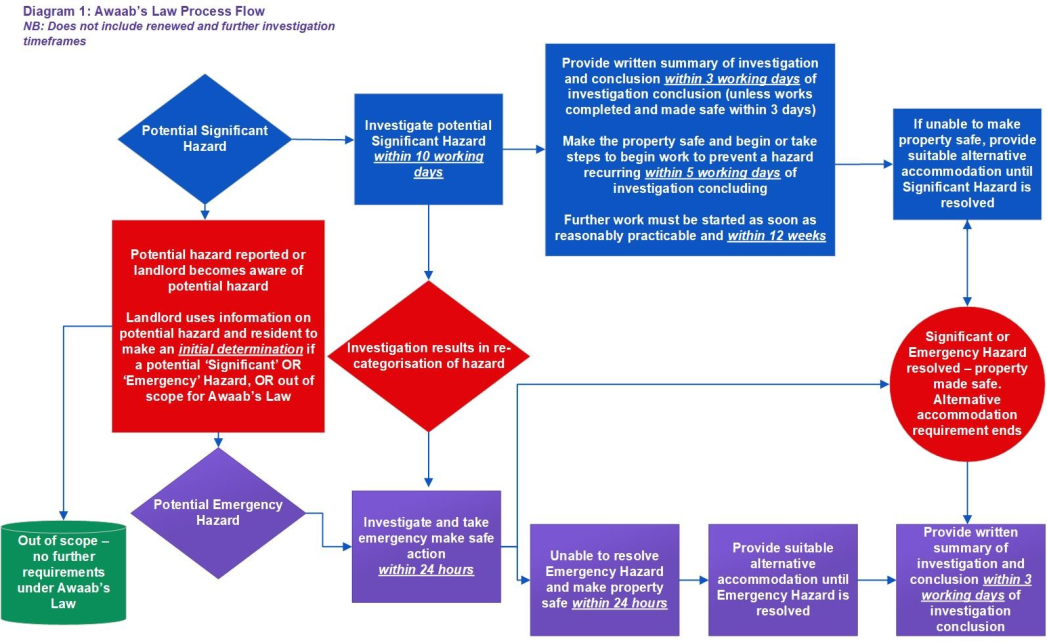
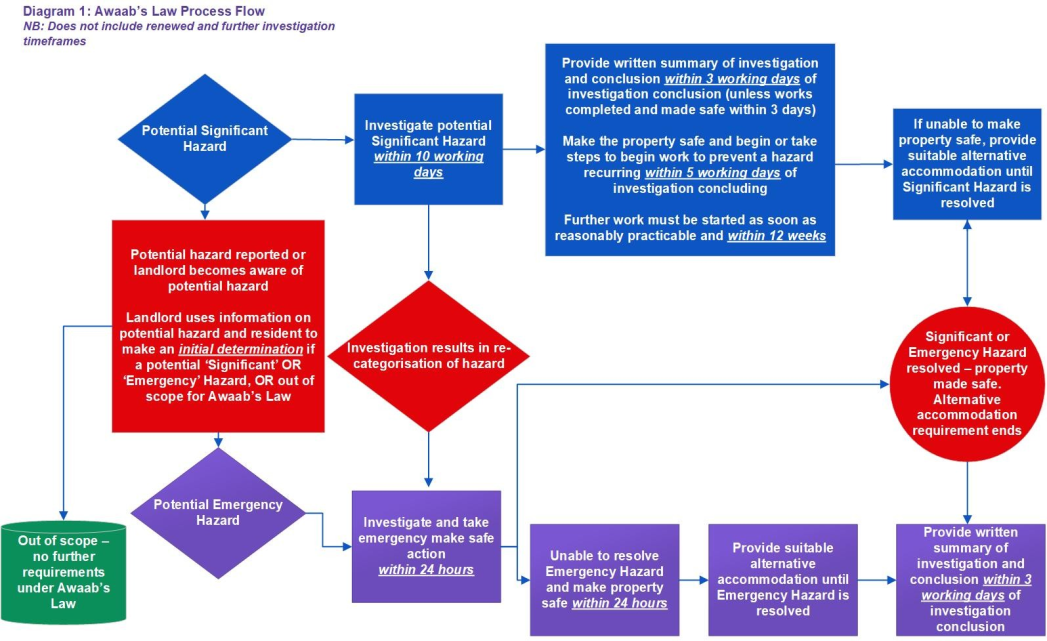
See the diagram and details of the process on the government website:
Contact details
- Housing Repairs
- Request a repair
- 01623 457999 for reporting Damp and Mould
-
Ashfield District Council
Northern Depot
Station Road
Sutton-in-Ashfield
Nottinghamshire
NG17 5HB
Downloads
Some files may not be accessible to everyone. You can request the file in a different format from the contact on this page.
Page last updated 26 August 2026
Page feedback
This form is for feedback on the content of this page.
Please do not use this form to contact us about personal matters, as we cannot respond to requests sent this way. To get in touch, use the contact details or online forms provided on this page.